



History
1950's
The beginning of a generation This writing in a way traces our family history back since the twentieth century to the present, telling about the dream of five young brothers who decided to make their musical passion as a livelihood, about 60 years ago.

By that time a debut in music had already come to light to the “Vicente” brothers. That was their primary musical education learnt about in the Philarmonic Band of Turquel (Portugal), their homeland. Thus, they joined on the youthful enthusiasm to a passion and created an orchestra of their own named ‘Orquestra Irmãos Vicentes’ back in 1951. (Free translation: Vincent Brothers Orchestra)
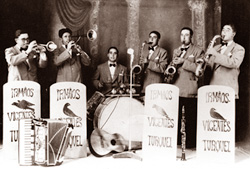
They created their own repertoire by composing original songs evoking life histories, passions, people and places. And they hit the road driving an old Studebaker acquired on sale.

As the orchestra toned up a greater feeling for the sound of music far beyond usual places and live journeys, they were getting a name wherever they performed and always asked to go back to countless places, more and more, pacing the endless rhythm of festivities and traditions.

All along the twentieth century, hundreds of philharmonic orchestras sowed the music in Portugal, mostly playing wind and percussion instruments performing here and there, or in a little village somewhere, growing out the hearing roots of the military bands.
Those philharmonics were the musical and cultural keynote up for the common citizen. Their schools and music academies taught thousands of people bringing them on music, and being a notable value for music and culture, lasting to these very days.
Those philharmonics were the musical and cultural keynote up for the common citizen. Their schools and music academies taught thousands of people bringing them on music, and being a notable value for music and culture, lasting to these very days.
1950's
1960's
1960's
National acknowledgment A few years later, the effort, performance and success brought about enjoyment and benefits to the orchestra. Nevertheless, the five musician brothers set up an industrial and commercial project running parallel to music, in the early 60s.
It was the dawn of new blowing winds coming from England and other countries to music. The Anglo-Saxon tones and rhythms were on the road then. Whether the orchestra ceased there would be therefore a B plan towards to another way of living.
It was the dawn of new blowing winds coming from England and other countries to music. The Anglo-Saxon tones and rhythms were on the road then. Whether the orchestra ceased there would be therefore a B plan towards to another way of living.
All through the 60th decade the ‘Orquestra Irmãos Vicentes’ was really in the groove and fairly known at national level. That was the time on the road to buy and sell musical instruments and accessories, being somewhat of a trade. This trade suddenly emerged as a business availed of the factual know-how coming by.
1970's
A new age From later 60s to early 70s the orchestra updated the mood. To ever live for the music in motion, far beyond the living passion of its musicians, the orchestra should play on the new born 'electric' roots: grooving sounds, innovative instruments, new melodies and rhythms.
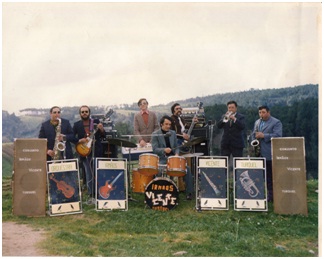
The earliest songs, originally composed by its musicians, mostly by one of them, Manuel Vicente, no longer beseemed with tides of English, French or Italian hits beating tops and audiences on the radio and TV shows.
That was the very beginning of a period when dance bands by the hundred came to light in Portugal. So the orchestra tuned in new moods and became 'Conjunto Musical Irmãos Vicente' (Free translation: Vincent Brothers Band)
Into the seventies the full Pop hit the spot. Each band was a prime source of inspiration for real. The public mood was changing dramatically as well. Music players and listeners were craving for newer sounds and technologies. It was then when pop music players entered the new formation in the band.
Within the Portuguese musical milieu, we were then listening to Hammond and Farfisa electronic organs, mastering sounds with their unique Leslie speakers and fulfilling keyboard players for years.
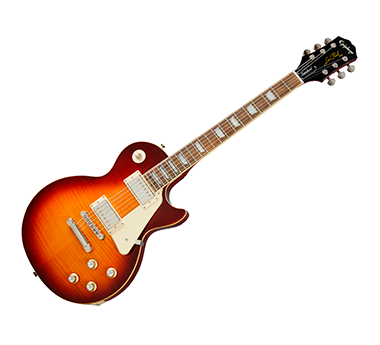
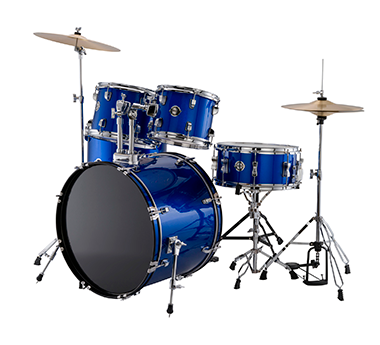
People were then also listening to famous Fender Rhodes pianos for the first time in a lifetime, likewise abroad. Fender, Gibson and Ibañez blasted their premieres. On drums we'd be soon listening to Ludwig, Premier and Pearl.
It was the age for open air concerts underneath the blazing sun or the loving moonlight, just like sequels to the mystique Woodstock 69, claiming for new sound systems, available for one and all bands, suddenly facing huge audiences and an hard working time all day long.
Everywhere, Public Access Systems (PAs), such as Dynacord, Montarbo, Semprini, FBT, M3 and more, hit the road to festivals or traditional festivities. They stirred emotions by the tough handling and stage setting, many a time ahead the show. Thus and so a new job was born and going by the name of 'roadies'.
1970's
1980's
1980's
Birth of Symphony shops Sinfonia brand stores

The 'Vincent Brothers Band' was then a lab for expertise in new instruments and rising technologies, which were meanwhile exploding on offer and variety to music business in late 70s and early 80s.
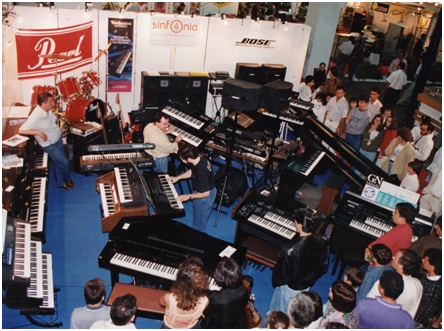
Gradually after the revolution on April 1974, Portugal adjusted the commercial management system and import laws. Many musicians had already made close contacts with music industry manufacturers and suppliers in the long run. So when technology suddenly came by all means onto the marketplace with no restriction or delay, music retailers broke ground and stepped out a major business in Portugal.
Roland SH-01 – The 80s
The first music shop owned by some members of the Vicente family, brand new named “Sinfonia”, opened up at Alcobaça in 1978 not far from Lisbon.
Soon Sinfonia was establishing shops in Leiria, Caldas da Rainha, Oporto and Lisbon. Moreover thousands of music lovers and musicians were often passing by and purchasing at the shops, or they even had their genesis as music lovers and instrumentalists simply because Sinfonia was there existing. Otherwise, lots of students were learning music those times at the widely known Sinfonia Music Academy.
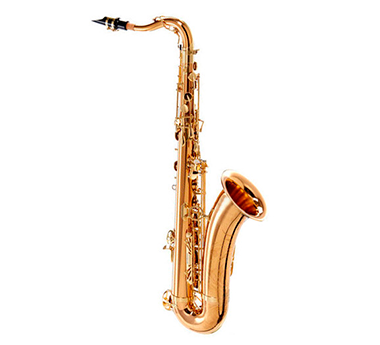
In the meantime, as Sinfonia broke through the business, the next generation of Vincent family headed towards the National Music Conservatory of Lisbon, graduating in different music studies such as composition, piano, trumpet, saxophone and teaching.
This next generation at once assumed the running business, due to a higher musical preparation and standpoint, which enabled them to expertise pioneer technologies and to be players on a growing business.
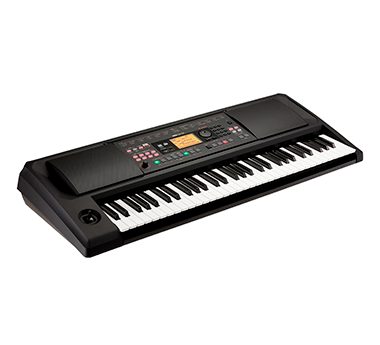
That was the time for the so-called 'Portuguese Rock Explosion'. Here and there hundreds of dance bands were already plugging their sounds, fast adding new demands onto the market and music sellers. Synthesizers and keyboards, Roland, Yamaha and Korg digital pianos, guitar accessories and many others were alive all over the road.
The 80s – National music fair
1990's
Since the 90's to the present day From the 90's to the present
From the 90s to the first decade of the current century, the different family groups directed towards diverse goals and activities once again.
Some family members kept on the music scope running the music trade or teaching in schools and academies. Another branch of the family has successfully opted for different industrial and commercial business-to-business areas, like visual communication and advertising industry.
In the late 90's the 'first' generation of the Vicente family was still preserving their lasting passion for music, represented by three brothers and musicians of the original orchestra, already retired from their professional activities.
1990's
2013
2013
Ludimusic Project Some contrary factors, as the economic crisis and the tough competition between major European online music stores, brought down the prices and charged the financial asset and competitiveness to major enterprises on music business in Portugal.

Gradually, the new online Portuguese consumer habits in addition to globalization effectFaqed one more victim. Forty years after a long running business and skilled know-how as music dealers, the trademark 'Sinfonia' came to an end and ceased the activity in 2012.
LudiMusic is completely a new project, costumer oriented to music technologies and instruments, originally designed to a customer focused performance, accordingly to the new rules rising from the global paradigm shifting.
This is an up-to-date online selling platform, offering a complete catalog, with focus on stocks for purchase as shown and immediate delivery. This online shopping will be strengthened, for the Portuguese market, through our music shops. We'll also be on marketing investment and offering a logistics system, interlinked with data access such as timing, transport or delivery to the costumer.