
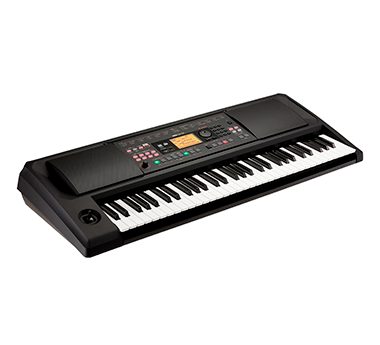


Korg Nautilus 61 Workstation
ID: ZMKGTEST060022
In stock
Accumulate discounts for your card
Best price on the market


Complete your purchase!
Some specifications are given below. For more detailed information go to our DOWNLOADS tab or the KORG website please.
Korg Nautilus 61 Workstation

To start, the enhanced SGX-2 piano sound generator offers delicate expressiveness to capture all the nuances of the acoustic piano, and NAUTILUS features the most piano libraries ever put into one product; with 12-step velocity-switched sound, string resonance and more. The EP-1 electric piano sound generator realistically reproduces seven different famous electric piano sounds.
The CX-3 engine – the heart of our sought-after CX-3 reissue -covers the distinct sound of classic tonewheel organs. Add to that MOD-7 VPM/FM synthesis, the PolysixEX and MS-20EX for analog modeling, and the STR-1 for physical modeling, and you have essentially an engine for any type of sound you’re looking to get. Used together in Program or Combination mode, these distinctive engines create completely new timbres.

This sound generator lets you perform with the sounds of famed grand pianos such as the German piano, on which the ambience sounds can be freely modified; or the Italian grand piano, whose sound is growing rapidly in popularity over recent years. These pianos offers delicate expressiveness to capture every last nuance of the acoustic piano, with 12-step velocity-switched sound, string resonance and more.
String resonance - With the damper pedal depressed, all of the piano strings are free to resonate. When any key is played on the piano, other strings that are pitch-related to the original key may begin to vibrate via sympathetic resonance. The SGX-2 accurately captures and recreates this sympathetic string resonance, adding an additional level of detail to the grand piano sound.

This dedicated electric piano sound generator realistically reproduces seven different famous electric piano sounds, with the addition of an earlier model featuring a characteristic distortion. The MDS (Multi-Dimensional Synthesis) technology eliminates the transitions between velocity-switched samples, and does away with the unnatural behavior of looped samples.
Smoothly responding to the nuances of the player's touch, yet allowing your performance to reach an energetic climax, this modelled engine features an astounding dynamic range that exceeds what one might expect from digital sound generation. For each of the seven different models, different amps, cabinets, speakers, and standard vintage effects are realistically simulated. From the samples to the touch and the effects, all aspects affecting the sound are coordinated into a single package, making this the ultimate electric piano.

The original KORG CX-3 combo organ went on sale in 1980. Loved by musicians around the world, this classic organ reappeared in 2000 as a new product with the same name, but using the latest technology. In NAUTILUS, the CX-3 engine precisely models this classic tonewheel instrument. Proprietary KORG technology has been used to perfectly reproduce the vacuum tubeamp, and effects such as Vibrato/Chorus.
Special attention was given to the rotary speaker effect, which lets you choose from seven types, as well as use the NAUTILUS' joystick in the X-axis to control the speed. Even the instability, fold-back, leakage, and noise of the tonewheels have been obsessively analyzed and recreated. The organ sounds heard in legendary performances—some recreated here by the original artists—are now yours for the playing. Experience these classic organ sounds, reborn for the present day.

HD stands for “High Definition” indicating the HD-1’s superior sound, starting with KORG’s proprietary low-aliasing sample playback oscillators, full-bandwidth multimode resonant filters, and extraordinarily fast & smooth envelopes and LFOs. The HD-1 is the most powerful PCM sound engine in KORG’s history, into which KORG has poured all the PCM know-how accumulated since the M1.
All of KORG's acclaimed PCM sounds are painstakingly created by specialized technicians. Data that was reluctantly omitted from previous models due to limited memory has now been called back into service on the NAUTILUS. The amount of waveform memory alone might rival a PC-based sound engine. Yet the real difference is in the completely different level of quality and finish that is obvious when you play these sounds as instruments on the NAUTILUS. The finest technicians, working on the finest platform, and aiming at the finest quality: that's the HD-1.

Packed with cutting-edge technology, NAUTILUS nonetheless has respect for the classics. The KORG MS-20 first appeared in 1978 and quickly captivated many synth fans with its rich personality marked by thick and solid sound, aggressive filters, and patching capability that provided nearly infinite possibilities for creating sound.
Using KORG’s CMT (Component Modeling Technology) the MS-20EX faithfully reproduces the MS-20 while dramatically expanding its patch panel functionality. Modulate filters with audio-rate oscillators; turn audio inputs into control signals; control all of the original knobs with mod sources including additional envelopes, LFOs, and real-time controllers. It’s a tweaker’s dream. And of course, the NAUTILUS version is now majorly polyphonic.

The Polysix first appeared in 1981, offering six-voice polyphony and program memory, and a surprisingly competitive price tag. With its self-oscillating four-pole filter, smooth analog oscillator and sub-oscillator, plus a lush Chorus/Ensemble effect, the PolysixEX extends the abilities of the original in many creative ways.
The strings and pads that were such a major feature of the Polysix will be invaluable when you need the sounds of the early '80s. The classic arpeggiator built into the original Polysix is also provided. As a bonus, it’s also capable of extremely high polyphony.


This sound engine uses VPM synthesis based on the VPM (Variable Phase Modulation) technology that powered two classic instruments, the Prophecy which appeared in 1995 and the Z1 which appeared in 1997 as a further evolution, and adds PCM sample playback, multi-mode filters, and external input to create a freely patchable semi-modular synthesizer.
Combine Variable Phase Modulation (VPM) from KORG’s classic Prohpecy and Z1, add in some wave-shaping, a little ring modulation, mix in a few samples, and add subtractive synthesis, plus a modular patch-panel system, and you have the MOD-7. Exceptionally versatile, it offers everything from classic FM keyboards, bells and basses (including the ability to import sounds from vintage DX synths) to rhythmic soundscapes and sparkling, epic pads.


With the DYNAMICS knob, you can instantly control the changes in volume and tone in response to how hard you play the keyboard (velocity); and you can customize this knob in real time to match the keyboard playing feel required for each style and song. Even when playing the same sound, you can turn this knob to get the feeling of playing a completely different sound. By finding just the right setting for your playing style, you'll uncover even more of the possibilities that the NAUTILUS offers.
When you activate the DYNAMICS knob and turn it to the left, the keyboard responds more softly to your playing, giving you a wide range of dynamics. This allows for delicate, expressive playing when accompanying a piano solo or vocals, which directly reflects the dynamics of your performance. On the other hand, turning the knob to the right gives a stronger, more flat dynamic response. This brings out the sound when you’re playing in a band or ensemble, which works best when performing with a more even feel.

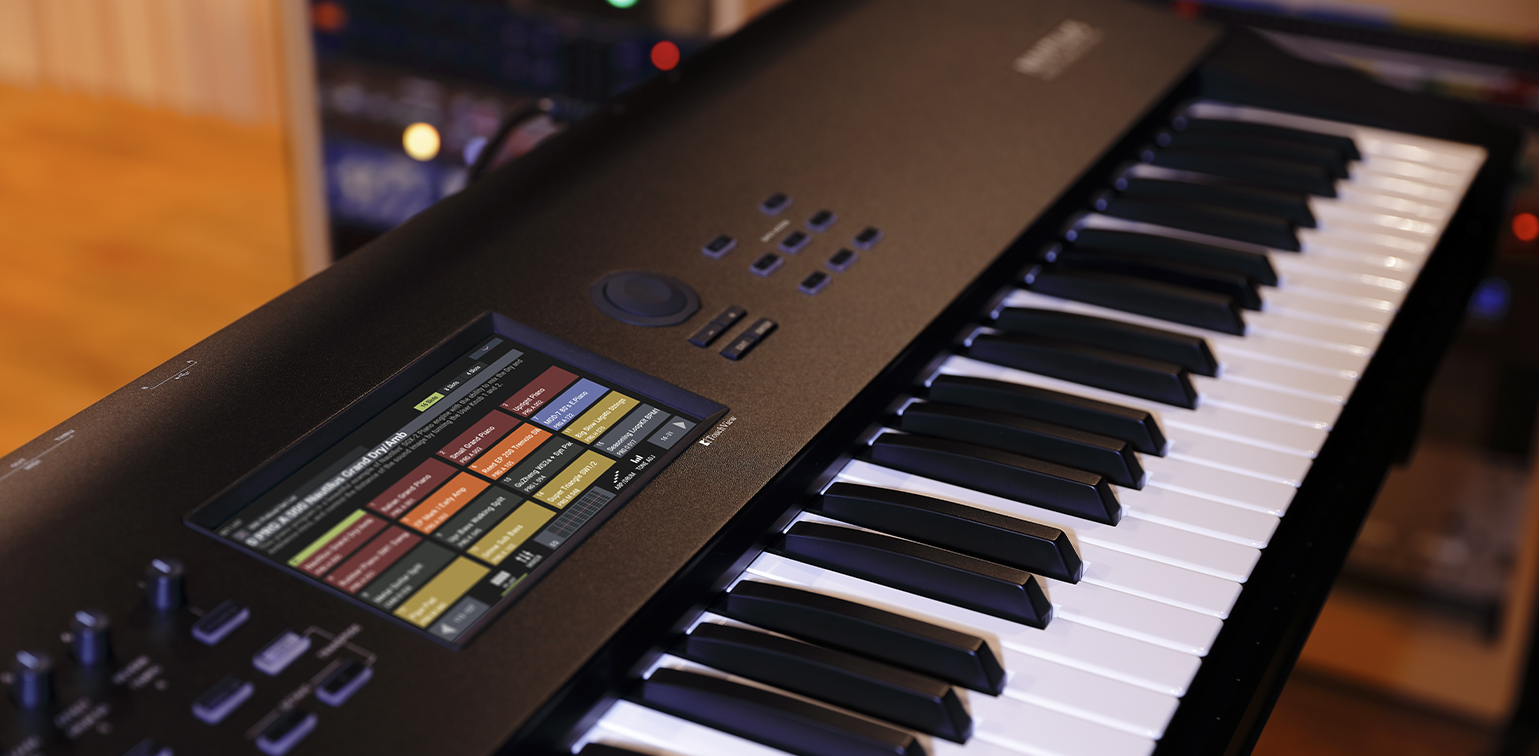
For the NAUTILUS, we have completely rethought the user interface, considering that panel controls tend to become denser as more functions are added. The interface of the NAUTILUS lets users find just the things they’re looking for once they understand the principles. The MODE button lets you see what you’ve selected in each mode on a single screen, from PROG and COMBI to the set list, sampling, sequence and global modes. Each mode has tabs for each function, and the PAGE buttons offer more detailed editing with consistent operations. With the user-friendly navigation of the NAUTILUS, you can press the MODE button at any time to return to the start if you get lost.
A dark mode is available for the display, using black as the primary color to reduce eye fatigue. Six quick access buttons are also available as shortcut buttons. The NAUTILUS further offers four templates as a continuation of the previous user-friendly features, which can be used to select modes like PROG and COMBI, as transport buttons for sequencer playback and recording and so on. You can also select your own settings as you like. What’s more, you can freely assign functions you frequently use and save them in one of four sets.
Using KORG’s Open Sampling System, NAUTILUS can quickly sample an external audio source, regardless of whether NAUTILUS is in the Program, Combination, or Sequencer modes. The Open Sampling Mode can even resample the performance of the NAUTILUS itself. The user sample bank, which extends the convenience of the EXs sample library to user samples, allows custom samples to be loaded and played, taking advantage of the gigantic SSD capacity. AIFF, WAV, SoundFont 2.0, and AKAI S1000/3000 format samples can be loaded into memory via USB memory.
Additionally, you can use a USB Ethernet adapter to exchange large amounts of sample data with your computer at high speed. Instruments or samples that you've previously created on your PC can be used to construct a music production setup based on just the NAUTILUS itself.

NAUTILUS features a sequencer/recording section that offers both 16 MIDI tracks plus 16 audio tracks; a great resource for putting together a dazzling performance or a brilliant production. MIDI sequencing makes it easy to capture ideas, inspiration, and pro-quality phrases using the Drum Track, or RPPR (Realtime Pattern Play/Recording) functions.
The 16-track audio recorder simultaneously captures up to four tracks of 16-bit/24-bit uncompressed data at a sampling rate of 48 kHz. Play along with recorded tracks, add effects, and then resample the NAUTILUS itself and place the resampled WAV files directly in a track. When polishing your tracks, feel free to use mixer automation and editing functions such as copy, paste, and normalize to get the results you want.
To start, the enhanced SGX-2 piano sound generator offers delicate expressiveness to capture all the nuances of the acoustic piano, and NAUTILUS features the most piano libraries ever put into one product; with 12-step velocity-switched sound, string resonance and more. The EP-1 electric piano sound generator realistically reproduces seven different famous electric piano sounds.
The CX-3 engine – the heart of our sought-after CX-3 reissue -covers the distinct sound of classic tonewheel organs. Add to that MOD-7 VPM/FM synthesis, the PolysixEX and MS-20EX for analog modeling, and the STR-1 for physical modeling, and you have essentially an engine for any type of sound you’re looking to get. Used together in Program or Combination mode, these distinctive engines create completely new timbres.
This sound generator lets you perform with the sounds of famed grand pianos such as the German piano, on which the ambience sounds can be freely modified; or the Italian grand piano, whose sound is growing rapidly in popularity over recent years. These pianos offers delicate expressiveness to capture every last nuance of the acoustic piano, with 12-step velocity-switched sound, string resonance and more.
String resonance - With the damper pedal depressed, all of the piano strings are free to resonate. When any key is played on the piano, other strings that are pitch-related to the original key may begin to vibrate via sympathetic resonance. The SGX-2 accurately captures and recreates this sympathetic string resonance, adding an additional level of detail to the grand piano sound.
This dedicated electric piano sound generator realistically reproduces seven different famous electric piano sounds, with the addition of an earlier model featuring a characteristic distortion. The MDS (Multi-Dimensional Synthesis) technology eliminates the transitions between velocity-switched samples, and does away with the unnatural behavior of looped samples.
Smoothly responding to the nuances of the player's touch, yet allowing your performance to reach an energetic climax, this modelled engine features an astounding dynamic range that exceeds what one might expect from digital sound generation. For each of the seven different models, different amps, cabinets, speakers, and standard vintage effects are realistically simulated. From the samples to the touch and the effects, all aspects affecting the sound are coordinated into a single package, making this the ultimate electric piano.
The original KORG CX-3 combo organ went on sale in 1980. Loved by musicians around the world, this classic organ reappeared in 2000 as a new product with the same name, but using the latest technology. In NAUTILUS, the CX-3 engine precisely models this classic tonewheel instrument. Proprietary KORG technology has been used to perfectly reproduce the vacuum tubeamp, and effects such as Vibrato/Chorus.
Special attention was given to the rotary speaker effect, which lets you choose from seven types, as well as use the NAUTILUS' joystick in the X-axis to control the speed. Even the instability, fold-back, leakage, and noise of the tonewheels have been obsessively analyzed and recreated. The organ sounds heard in legendary performances—some recreated here by the original artists—are now yours for the playing. Experience these classic organ sounds, reborn for the present day.
HD stands for “High Definition” indicating the HD-1’s superior sound, starting with KORG’s proprietary low-aliasing sample playback oscillators, full-bandwidth multimode resonant filters, and extraordinarily fast & smooth envelopes and LFOs. The HD-1 is the most powerful PCM sound engine in KORG’s history, into which KORG has poured all the PCM know-how accumulated since the M1.
All of KORG's acclaimed PCM sounds are painstakingly created by specialized technicians. Data that was reluctantly omitted from previous models due to limited memory has now been called back into service on the NAUTILUS. The amount of waveform memory alone might rival a PC-based sound engine. Yet the real difference is in the completely different level of quality and finish that is obvious when you play these sounds as instruments on the NAUTILUS. The finest technicians, working on the finest platform, and aiming at the finest quality: that's the HD-1.
Packed with cutting-edge technology, NAUTILUS nonetheless has respect for the classics. The KORG MS-20 first appeared in 1978 and quickly captivated many synth fans with its rich personality marked by thick and solid sound, aggressive filters, and patching capability that provided nearly infinite possibilities for creating sound.
Using KORG’s CMT (Component Modeling Technology) the MS-20EX faithfully reproduces the MS-20 while dramatically expanding its patch panel functionality. Modulate filters with audio-rate oscillators; turn audio inputs into control signals; control all of the original knobs with mod sources including additional envelopes, LFOs, and real-time controllers. It’s a tweaker’s dream. And of course, the NAUTILUS version is now majorly polyphonic.
The Polysix first appeared in 1981, offering six-voice polyphony and program memory, and a surprisingly competitive price tag. With its self-oscillating four-pole filter, smooth analog oscillator and sub-oscillator, plus a lush Chorus/Ensemble effect, the PolysixEX extends the abilities of the original in many creative ways.
The strings and pads that were such a major feature of the Polysix will be invaluable when you need the sounds of the early '80s. The classic arpeggiator built into the original Polysix is also provided. As a bonus, it’s also capable of extremely high polyphony.
This sound engine uses VPM synthesis based on the VPM (Variable Phase Modulation) technology that powered two classic instruments, the Prophecy which appeared in 1995 and the Z1 which appeared in 1997 as a further evolution, and adds PCM sample playback, multi-mode filters, and external input to create a freely patchable semi-modular synthesizer.
Combine Variable Phase Modulation (VPM) from KORG’s classic Prohpecy and Z1, add in some wave-shaping, a little ring modulation, mix in a few samples, and add subtractive synthesis, plus a modular patch-panel system, and you have the MOD-7. Exceptionally versatile, it offers everything from classic FM keyboards, bells and basses (including the ability to import sounds from vintage DX synths) to rhythmic soundscapes and sparkling, epic pads.
With the DYNAMICS knob, you can instantly control the changes in volume and tone in response to how hard you play the keyboard (velocity); and you can customize this knob in real time to match the keyboard playing feel required for each style and song. Even when playing the same sound, you can turn this knob to get the feeling of playing a completely different sound. By finding just the right setting for your playing style, you'll uncover even more of the possibilities that the NAUTILUS offers.
When you activate the DYNAMICS knob and turn it to the left, the keyboard responds more softly to your playing, giving you a wide range of dynamics. This allows for delicate, expressive playing when accompanying a piano solo or vocals, which directly reflects the dynamics of your performance. On the other hand, turning the knob to the right gives a stronger, more flat dynamic response. This brings out the sound when you’re playing in a band or ensemble, which works best when performing with a more even feel.
For the NAUTILUS, we have completely rethought the user interface, considering that panel controls tend to become denser as more functions are added. The interface of the NAUTILUS lets users find just the things they’re looking for once they understand the principles. The MODE button lets you see what you’ve selected in each mode on a single screen, from PROG and COMBI to the set list, sampling, sequence and global modes. Each mode has tabs for each function, and the PAGE buttons offer more detailed editing with consistent operations. With the user-friendly navigation of the NAUTILUS, you can press the MODE button at any time to return to the start if you get lost.
A dark mode is available for the display, using black as the primary color to reduce eye fatigue. Six quick access buttons are also available as shortcut buttons. The NAUTILUS further offers four templates as a continuation of the previous user-friendly features, which can be used to select modes like PROG and COMBI, as transport buttons for sequencer playback and recording and so on. You can also select your own settings as you like. What’s more, you can freely assign functions you frequently use and save them in one of four sets.
Using KORG’s Open Sampling System, NAUTILUS can quickly sample an external audio source, regardless of whether NAUTILUS is in the Program, Combination, or Sequencer modes. The Open Sampling Mode can even resample the performance of the NAUTILUS itself. The user sample bank, which extends the convenience of the EXs sample library to user samples, allows custom samples to be loaded and played, taking advantage of the gigantic SSD capacity. AIFF, WAV, SoundFont 2.0, and AKAI S1000/3000 format samples can be loaded into memory via USB memory.
Additionally, you can use a USB Ethernet adapter to exchange large amounts of sample data with your computer at high speed. Instruments or samples that you've previously created on your PC can be used to construct a music production setup based on just the NAUTILUS itself.
NAUTILUS features a sequencer/recording section that offers both 16 MIDI tracks plus 16 audio tracks; a great resource for putting together a dazzling performance or a brilliant production. MIDI sequencing makes it easy to capture ideas, inspiration, and pro-quality phrases using the Drum Track, or RPPR (Realtime Pattern Play/Recording) functions.
The 16-track audio recorder simultaneously captures up to four tracks of 16-bit/24-bit uncompressed data at a sampling rate of 48 kHz. Play along with recorded tracks, add effects, and then resample the NAUTILUS itself and place the resampled WAV files directly in a track. When polishing your tracks, feel free to use mixer automation and editing functions such as copy, paste, and normalize to get the results you want.
Related
Recommendations
| 5 stars | 0% | |
| 4 stars | 0% | |
| 3 stars | 0% | |
| 2 stars | 0% | |
| 1 star | 0% |